 Skip to content

process, benefits and value

We have explored this topic several times before, but perhaps now more than ever it feels important to look at it again and shine a light on the advantages of recycling your gold.
For this reason, we decided to gather the most frequently asked questions on the subject in one virtual place. Our goal is to answer the most common doubts, give you one more reason to visit us at the Lab and—why not—help you discover that the gold pieces sitting forgotten in your drawer could be transformed into the jewel you have always loved and can’t wait to wear.

one
WHAT DO WE MEAN BY GOLD RECYCLING?
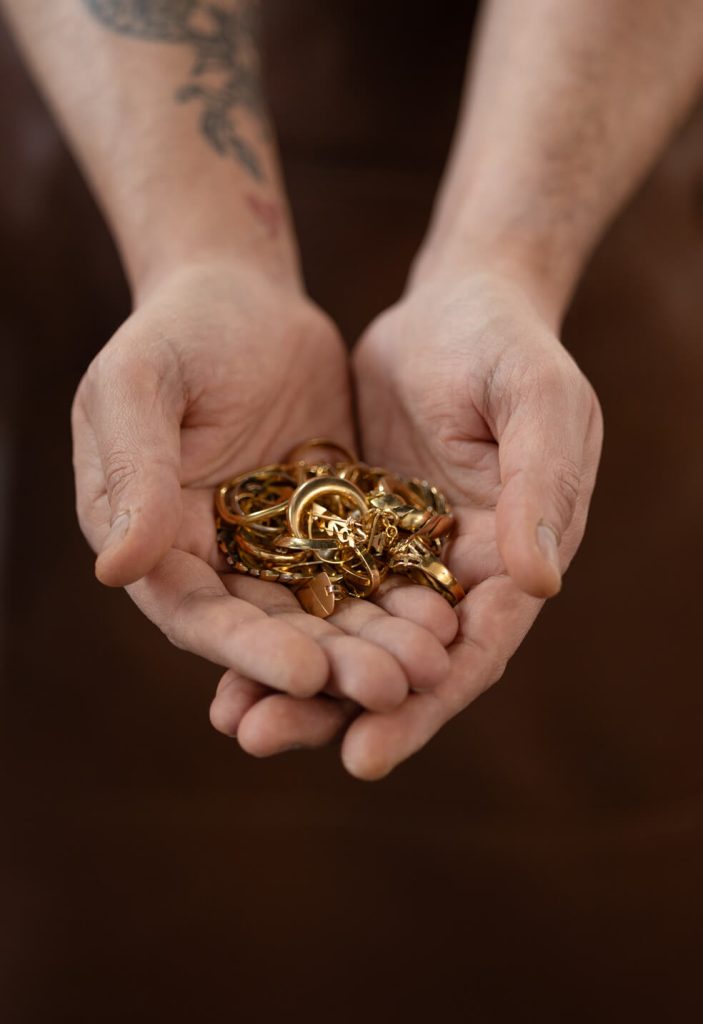
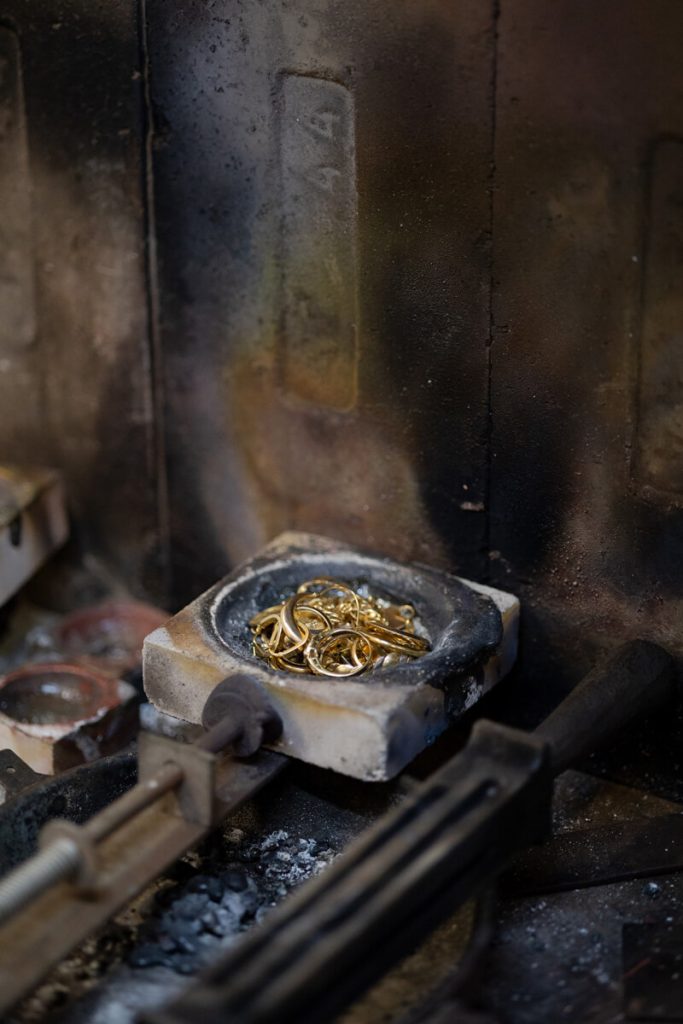
When we talk about gold recycling, we are referring to a recovery process that involves two essential steps: melting and refining. Simply melting gold is not enough to reuse it and create new jewellery. Before it can be used again, the metal must first be returned to its pure state (24 carats), removing other metals, impurities and previous alloys through a process called refining.
From a purely technical perspective, it is possible to work the metal directly after melting. However, without removing the alloys resulting from previous processes, it becomes very difficult to guarantee that the composition of the new jewel complies with legal standards.
In practical terms, whenever we create a new jewel in the Lab and stamp it 18k gold (750‰), it means that the piece is made with certainty of 75% pure gold and 25% alloy, composed of copper and silver. These metals are added both to make the gold less soft—and therefore easier to work with—and to give it the desired colour.
***
Answering this first question naturally leads to another one, which in some cases can be a real concern:
Can the new jewel be made exactly from my gold?
When a piece of jewellery is a true family heirloom, its emotional value can be far greater than its economic one. In these cases, people often find themselves facing a difficult choice. The recycling process does not take place individually for each piece brought to the Lab. Once the metal has been melted and refined back to pure gold, it becomes absolutely impossible to trace it back to the original jewels
A situation we see very often is when someone wishes to transform their grandparents’ wedding bands into a new pair of rings.
We completely understand how difficult it can be to part with something so meaningful. For this reason, in these situations we often suggest alternatives to melting, proposing modifications while keeping the original rings as a base.
Sometimes a small restyling is enough to see them in a new light: a careful cleaning and polishing, resizing the rings and adding a new engraving inside (replacing or placed alongside the original one). In other cases, it may be enough to add one or more stones, or to change the finish of the metal, giving the surface a more contemporary texture.
If, however, the original shape is not the one you would like, or if you prefer to create the rings in a different gold colour, then the only way to transform them is through melting and refined. At the end of the process, the gold will not be exactly the same as that of the original bands—but we like to think that helping create a symbol that truly belongs to you would make your grandparents happy as well.
two
WHAT ARE THE ADVANTAGES — AND FOR WHOM?
First of all, it is important to highlight two key facts:
- Recycled gold has the same physical characteristics and purity as newly mined gold.
- Gold can be recycled an infinite number of times without losing its qualities.
Once any doubts about quality have been cleared up, we can talk about the real advantages. Recycling can make your jewellery even more special for two reasons:
one ecological and ethical, and one economic
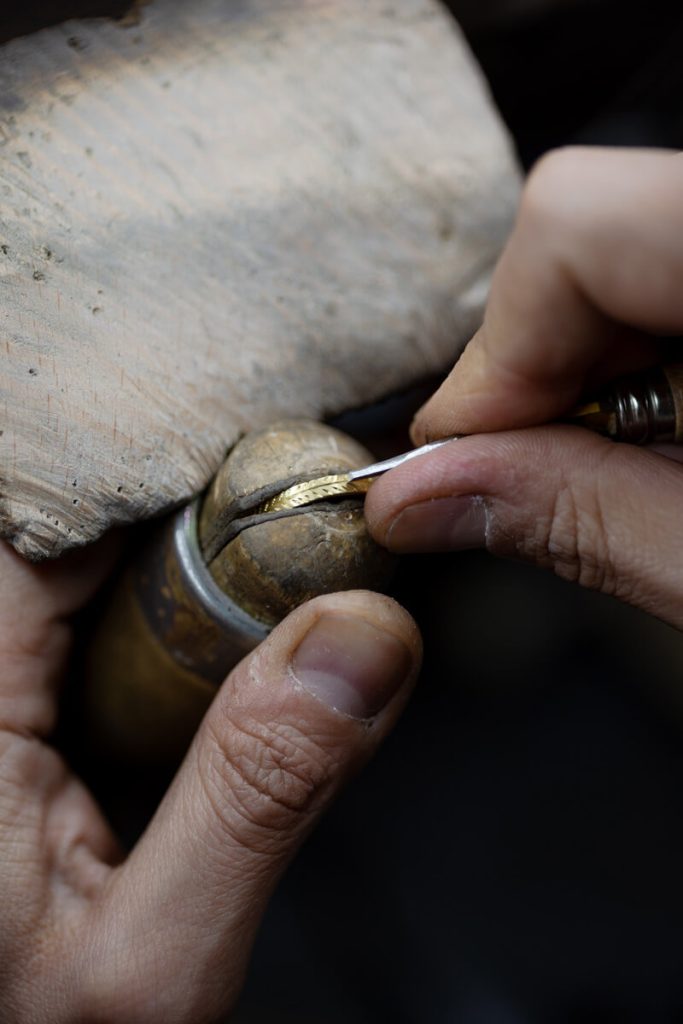
Ecological and ethical, because like all recycling processes, it allows an object to be transformed through steps that have a significantly lower environmental impact than extracting raw materials from the earth.
Economic, because the cost of the raw material needed to create a new jewel is fully or partially covered by the gold you already own.
three
WHICH JEWELS CAN BE RECYCLED?
To answer this question, I’ll start with the simplest possible example—something that many of us millennials share as the slightly unaware protagonists of true “gold baptisms”… not to mention First Communions.
Do you remember all those little chains, bracelets, pendants and rings you were given as a child but never actually wear?
Exactly. Those are perfect candidates—but they are certainly not the only ones.
Any piece made of gold, whether old or new, can be recycled..
It doesn’t matter what colour the gold is, or whether the jewellery is mismatched, broken or worn;
It doesn’t matter if you only have a few pieces, if they include stones, contain mechanisms (such as gold watches), or are unusual objects—like gold teeth (yes, even those work);
It doesn’t matter if they have different gold purities: 999,9‰ (24k), like gold bars, 900‰ (22k), like many gold coins and sovereigns, 750‰ (18k), like most jewellery traditionally made in Italy, 585 ‰ (14K), like many pieces produced in America, France or Germany, or 375 ‰ (9k), like most jewellery made in the United Kingdom;
and it doesn’t even matter if you are not entirely sure whether your pieces are actually made of gold…
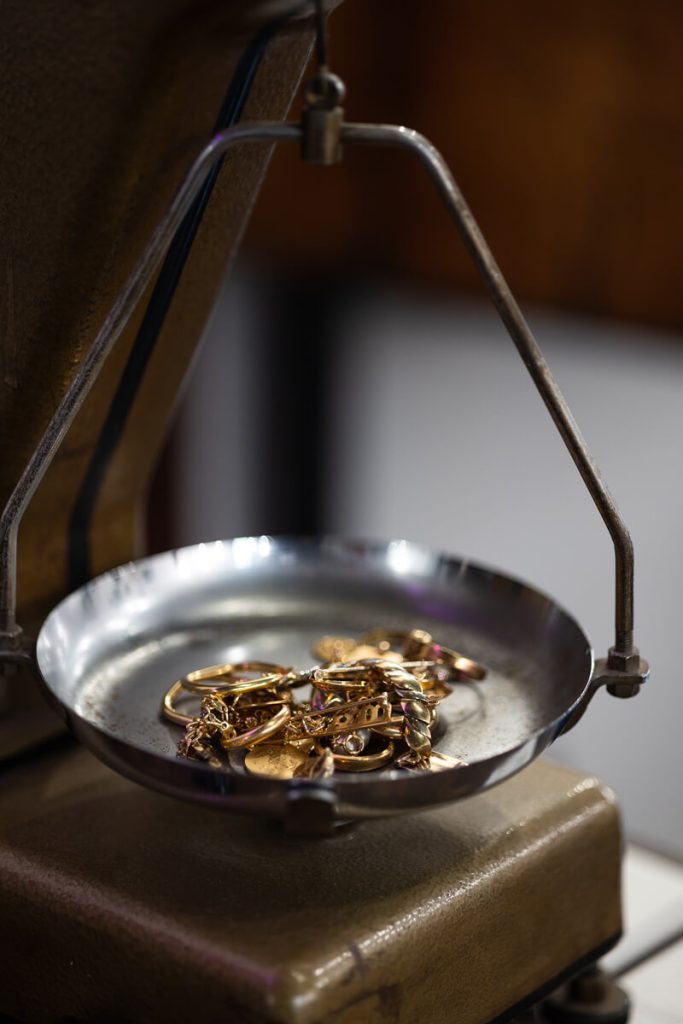
Once you bring them to the Lab, every item will be weighed and evaluated, and you will receive all the information you need to decide if—and how—you would like to proceed.
***
Based on the requests we have received in recent years, it may also be useful to mention
what cannot be recycled in the Lab
We cannot extract gold from industrial scrap, electronic components or raw gold nuggets.
Likewise, jewellery, ornaments or other objects that are gold-plated cannot be recycled. These pieces are made from another metal (copper, nickel, brass…) and only coated with a very thin layer of gold, which makes them unsuitable for this type of process.
What if family jewellery is very old?
Finally, a brief note about certain pieces—jewellery, watches or antiques—that, because of their craftsmanship, signature or historical period, may have an artistic or historical value greater than the value of the raw material itself.
In these cases, we usually recommend consulting an expert appraiser or an antique dealer before deciding to have them melted.
four
CAN I SEND YOU THE GOLD I WOULD LIKE TO RECYCLE?
Unfortunately, no.
Most of the orders we receive come from clients who do not live in Genoa, so we know that not being able to ship the gold you wish to transform can represent a significant logistical challenge, however, because gold is a precious raw material, its collection is subject to strict regulations designed to prevent money laundering and the handling of stolen goods.
Among other things, we are required to keep a dedicated register, maintain a photographic archive of the objects we collect and wait at least ten days before proceeding with the melting of any jewellery.
Beyond these bureaucratic reasons, collecting the gold in person at the Lab is also important for transparency and protection—for both you and us. It often happens that not all the jewellery intended for recycling is actually made of gold, sometimes even when people are convinced that it is. Being able to evaluate and weigh each piece together is therefore essential.
And finally, let’s admit it—coming to Genoa is always a wonderful idea. It is also a perfect opportunity to break down the virtual barrier and talk about beautiful things within the welcoming walls of the Lab.

